
Stafford County Criminal Docket Searches
Begin at the Kansas District Court Public Access Portal. Pick Stafford County as your location. Enter a case number if you have one. A name search should follow the portal guide's Last, First order. Search Type also lets you look by citation number, attorney, judicial officer, or another supported field. The result is a locator, not a file. It points to basic case information and the events index, which is short of the complete criminal record. Stafford County runs no separate county criminal portal. If Smart Search comes up empty, the matter may be a city ordinance case rather than a Kansas District Court case. Try a wider date range or the older number style. Or ask the Clerk of the District Court to check the public terminal and the court index.
- Open Smart Search and accept the terms shown by the live system.
- Set Location to Stafford County and enter the case number or name.
- Choose the criminal case type only after a broad search if needed.
- Open the likely match and read events in date order.
- Confirm a court date or request a copy from the clerk.
Stafford CR Numbers After Odyssey
Recent Stafford County criminal cases carry the Odyssey county-prefix numbering. Picture SF-2022-CR-000001. SF marks Stafford. Four digits give the year. CR signals a criminal case, and six digits form the sequence. That number is a format example only, not a real case. The official Odyssey format guide breaks down each part. The 20th Judicial District joined the Odyssey track in July 2022. An older Stafford County criminal docket may therefore still show a pre-prefix number. A failed exact-number search can reflect that format change rather than a missing file. Give the clerk the old number, the approximate year, the names, and the case type. Staff can then find the right index.
Criminal Dockets: What They Show
Think of the Stafford County criminal events index as a dated outline of court activity. Entries may show the court and case type. Entries may also show the filing date, the public caption, and the assigned judicial officer. You may also see the public charge description, settings, pleas, and motions. Orders, diversion events, disposition, and sentence can appear too. So can costs, appeal events, and document-access labels. What appears depends on the case and on access rules. A restricted link does not mean the public can get that document somewhere else.
| Case number | Stafford prefix, year, CR type, and sequence for a newer Odyssey case. |
|---|---|
| Charge event | The filed offense description when public; filing is not a finding of guilt. |
| Setting | Arraignment, pretrial, plea, trial, sentencing, or another scheduled event. |
| Plea and order | A recorded plea and later court rulings, each read in chronological context. |
| Disposition | The court's final result as entered, which may include dismissal or judgment. |
| Document label | A link, unavailable marker, redaction, or restriction status for the filed item. |
The index is not the whole file. Pleadies, exhibits, affidavits, transcripts, and law-enforcement files sit outside it. Ask the Stafford County District Court clerk about the exact filing and whether a plain or certified copy exists.
Stafford Criminal Entries Need Context
A filed charge is an accusation, not a conviction. A plea is not always the last event. A reset just moves a setting; it is not a dismissal. Diversion is a program event, distinct from expungement. These distinctions matter because the Stafford County criminal docket is a timeline, and one line pulled out of it can mislead without the entries around it.
- Arraignment
- A hearing at which the charge is presented and a plea may be entered.
- Continuance
- A court-approved move of a hearing to a later date.
- Disposition
- The formal result recorded for a charge or case.
- Diversion
- A conditional program path that does not itself erase the docket.
- Expungement
- A statutory court process that can limit later public access when granted.
Read the exact entry text and the current status. If the meaning stays unclear, ask the clerk for the public record instead of inferring an outcome.
Criminal Case Stages on the Docket
A Stafford County criminal docket grows entry by entry. The clerk records each filed act and each court setting. Not every case hits every stage. Motions, waivers, diversion, or a court ruling can change the order too. Still, the common path helps a reader place one event in context.
Docket flow: Filing › Arraignment › Pretrial › Plea or Trial › Disposition › Sentencing
A motion or order can land between any of these points. Where a conviction applies, sentencing follows. A dismissal may end a charge earlier still. An appeal or post-judgment filing can reopen the chronology after disposition, but the current Stafford County criminal docket controls, not the model sequence.
Stafford Criminal Filing Scale
The 2024 Criminal Filings report counts 42 Stafford felony filings and 32 misdemeanor filings. Its pending columns show a different measure. Those hold 44 felony and 30 misdemeanor matters. The over-12-month percentages there are 31.8% and 53.3%. Keep those headings attached to their figures, since pending counts are not new filings.
These totals describe court-system workload. They do not list people, prove guilt, or predict any single Stafford County criminal case. Read each public docket on its own entries.
Stafford County Criminal Docket Courts
Felony and misdemeanor cases under state law belong in the Kansas District Court, Stafford County. It sits in the five-county 20th Judicial District. The District Magistrate Court sits inside that structure. It takes the matters assigned to the magistrate judge. Judy Lyon, Clerk of the District Court, keeps those Stafford County criminal dockets. A district judge or administrator may work elsewhere in the district. Municipal courts stand apart. St. John and Stafford run their own dockets. Those cover city ordinance and city-traffic matters, handled through their own clerks. A ticket or complaint under a city code may never surface as a Stafford County District Court result. Read the issuing court on the citation or notice. The County Clerk is a separate office too. It does not keep District Court criminal events.
| Matter | Likely court | Custodian |
|---|---|---|
| State felony or misdemeanor | Stafford County District Court | Clerk of the District Court |
| Assigned lower-level state matter | District Magistrate Court | Clerk of the District Court |
| City ordinance offense | Issuing municipal court | City municipal clerk |
Stafford Diversion Does Not Reset Court
Diversion in Stafford County is a program route, not a pass around the courthouse. The Stafford County Attorney diversion application covers certain citation and criminal matters. It sets a $50 application fee. That fee is nonrefundable, and it must arrive by cashier's check or money order. The standard term runs six months. The program can extend it. Acceptance is never guaranteed. Program fees sit apart from court costs, fines, and restitution. Those can all remain owed separately. One point matters most: filing the application does not excuse a court setting. The paperwork sends court-date questions to the District Court clerk. It requires the applicant to be on diversion within 45 days of the citation. Otherwise the applicant appears before the judge. A pending application tells you nothing about whether a Stafford County criminal court date moved. Call the clerk at (620) 549-3295. That number confirms the active setting.
Keep the channels separate: the County Attorney handles the diversion application, while the District Court clerk confirms docket events and court dates.
Access Rules for Criminal Dockets
Eligible Stafford County criminal case information can appear online. But Kansas law splits access into levels. Kansas Supreme Court Rule 22 governs public electronic District Court records. It allows the web portal and a courthouse terminal. Some public converted documents show at the terminal yet never reach the web. For anything the portal withholds, the clerk counter on the third floor at 209 N Broadway in St. John is the practical fallback during posted weekday hours. The phone line answers at (620) 549-3295.
When you request a document, name Stafford County District Court. Give the case number or approximate year. Describe the exact item, and say whether a plain or certified copy is needed. Ask the clerk for the current copy fee before sending payment. Confirm the delivery method too, since mail and fax depend on the clerk's okay. A Kansas court records request form offers one more written route for the filing.
Key rules:
Kansas Supreme Court Rule 22 sets portal and courthouse-terminal access and excludes some case types from online view.
Kansas Supreme Court Rule 24 protects listed personal identifiers in court filings.
K.S.A. 21-6614 governs eligible expungement petitions and their effect on access.
Juvenile, expunged, sealed, grand-jury, search-warrant, and other sensitive matters can be restricted or missing from the online portal. A blank result is not proof that no Stafford County criminal docket exists.
Stafford Portal and Court Images
The Kansas Central Payment Center runs the state's combined payment and court-search route. Through it, some traffic or criminal matters can surface.
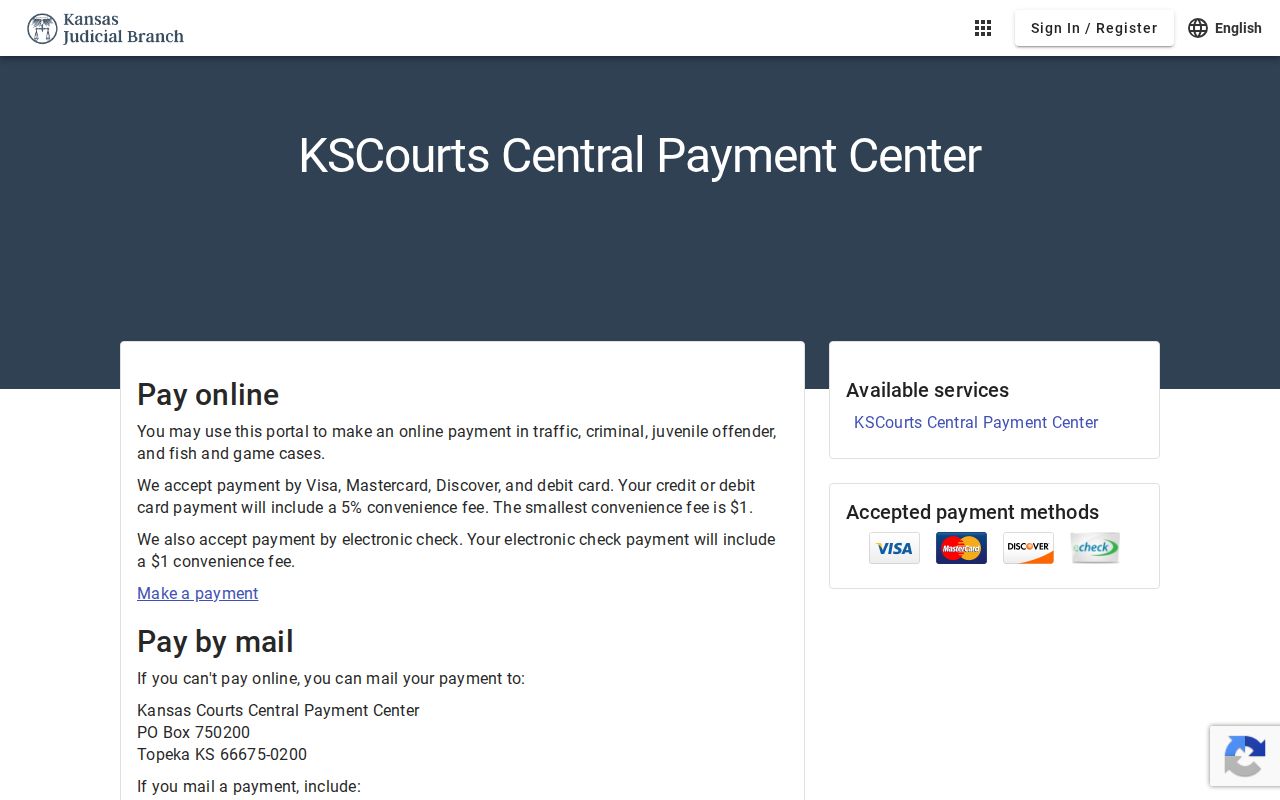
That tool is no standalone index. Smart Search and the District Court clerk remain the real record routes for Stafford events.
The U.S. District Court for the District of Kansas belongs to an entirely separate system, one that handles federal criminal dockets rather than county ones.
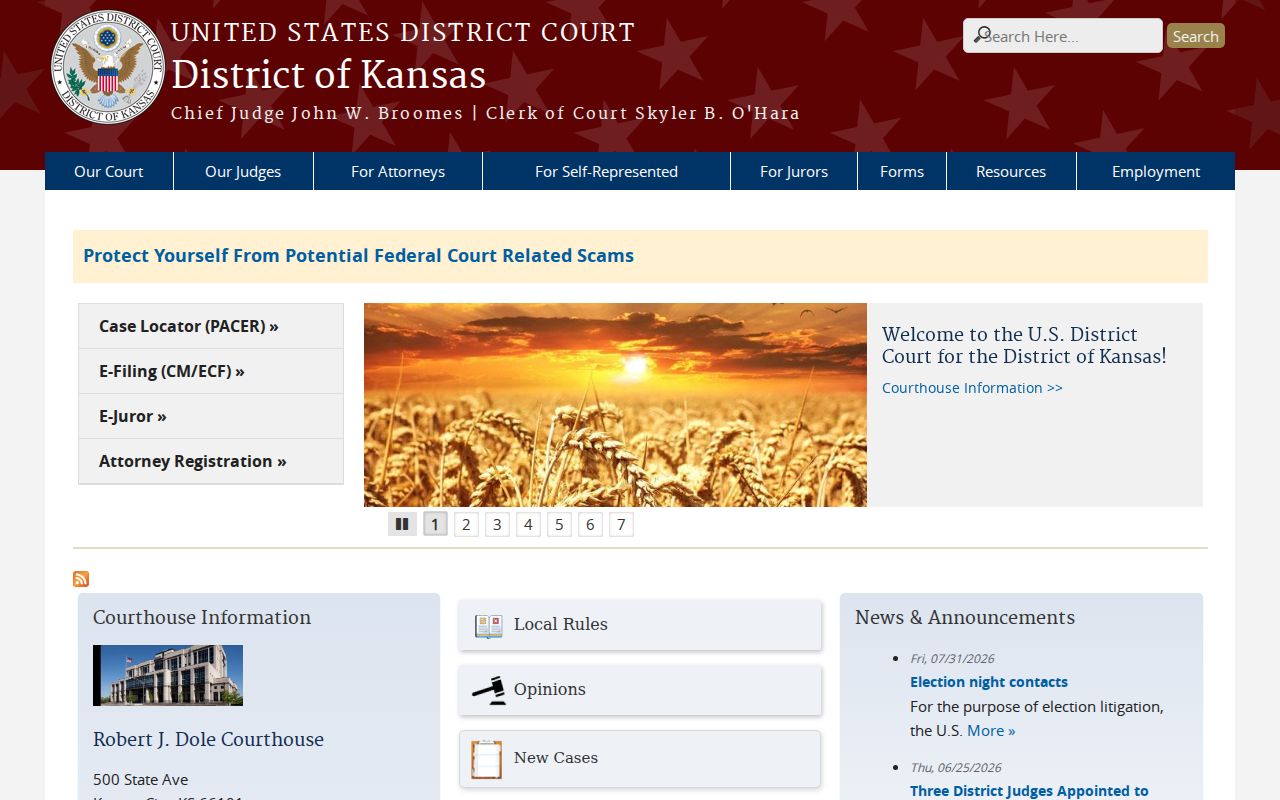
A federal case lives in PACER or the federal clerk's system. It will not appear in the Stafford County District Court search.